

Most british adults will face some degree of hearing loss by age 70, yet the differences between traditional and digital hearing aids are often misunderstood. With so many choices on the market, selecting the right technology can feel confusing. This overview brings clarity to the key distinctions, showing how evolving hearing aid designs impact daily life, long-term comfort, and personal wellbeing.
Table of Contents
- Defining Traditional and Digital Hearing Aids
- Key Differences in Technology and Performance
- Features, Use Cases, and User Experience
- Cost Comparison and Access in the UK
- Buying Through NHS, High Street, or Online
Key Takeaways
| Point | Details |
|---|---|
| Technological Evolution | Traditional hearing aids provide basic sound amplification, while digital hearing aids utilise advanced technology for improved sound processing and clarity. |
| Performance Advantages | Digital hearing aids outperform traditional aids in challenging environments by enhancing speech recognition and reducing background noise. |
| Diverse User Needs | Modern hearing aids offer features tailored to lifestyle and individual hearing requirements, promoting better user satisfaction and adaptability. |
| Purchasing Options | Consumers can choose between NHS provision, private clinics, or online platforms, each with unique benefits and cost implications. |
Defining Traditional and Digital Hearing Aids
Hearing loss solutions have dramatically evolved over the past decades, transforming from simple sound amplification devices to sophisticated digital technologies. Traditional hearing aids and digital hearing aids represent two distinct technological approaches to addressing hearing challenges, each with unique characteristics and capabilities.
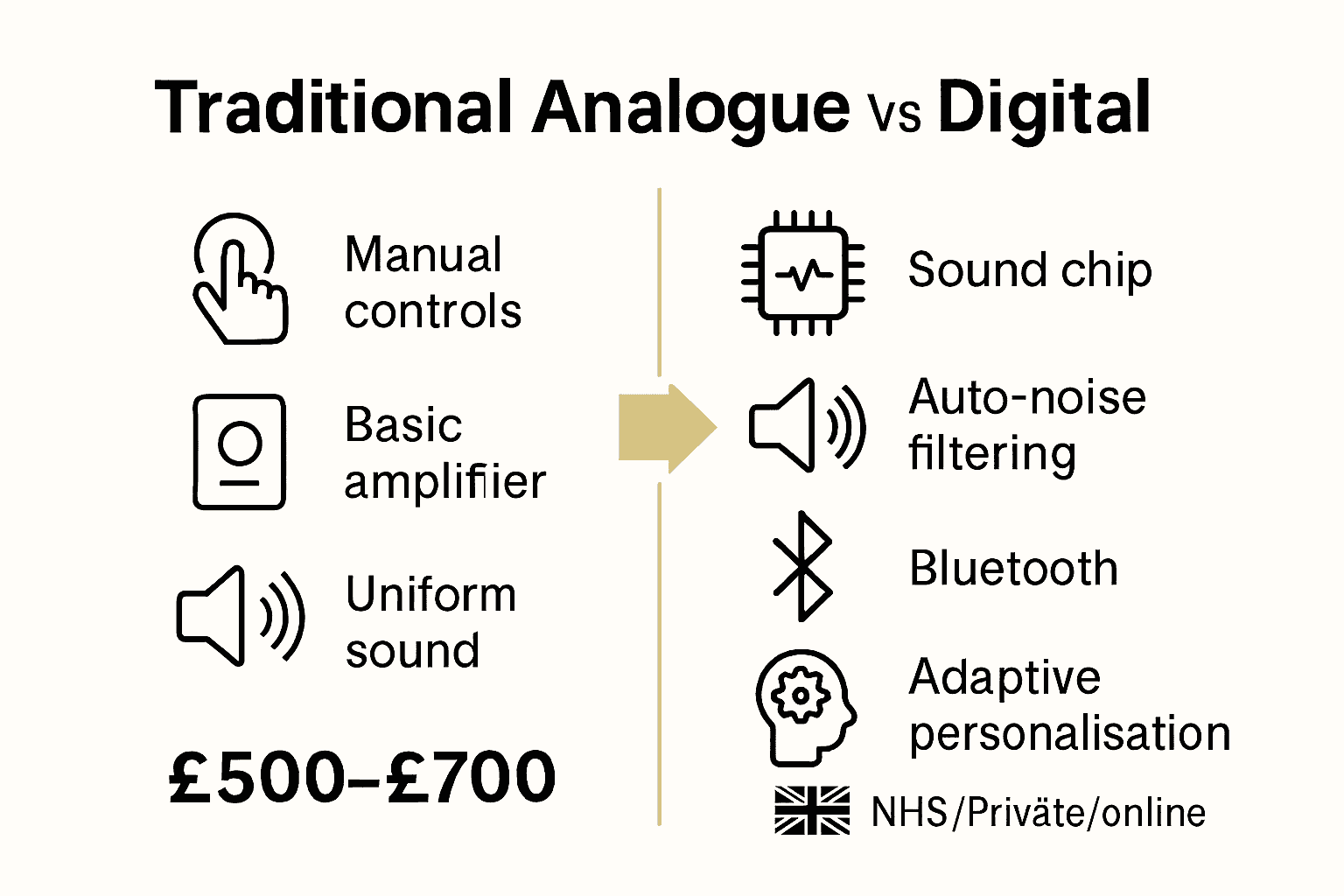
Traditional hearing aids, also known as analogue devices, operate on a straightforward principle of sound amplification. According to research from cehh.press.lshtm.ac.uk, these devices use a basic microphone and amplifier system to increase sound volume. They typically involve manual adjustments, allowing users to modify sound quality through physical controls like volume wheels. Users must manually adapt settings based on their environment, which can be less convenient and precise.
Digital hearing aids represent a significant technological leap forward. As documented by eprints.soton.ac.uk, these advanced devices utilize digital signal processing chips that transform sound waves into digital signals. This technological innovation enables multiple remarkable features:
- Multiple frequency channel processing
- Automatic noise reduction capabilities
- Advanced feedback cancellation
- Enhanced speech recognition algorithms
- Personalised sound profile customisation
Unlike traditional analogue devices that amplify all sounds equally, digital hearing aids can selectively process and enhance specific sound frequencies. This means they can provide a more nuanced, personalised hearing experience, adapting dynamically to different acoustic environments. Whether you’re in a quiet room or a noisy restaurant, digital hearing aids can automatically adjust to optimise sound clarity and reduce background interference.

The primary distinction lies in their technological approach: traditional aids amplify sound uniformly, while digital aids intelligently process and modify sound signals. For individuals experiencing hearing loss, understanding these differences can help make a more informed decision about which type of hearing aid might best suit their specific needs and lifestyle.
For a deeper understanding of hearing aid technologies, check out our guide on hearing enhancement technology.
Key Differences in Technology and Performance
Understanding the technological nuances between traditional and digital hearing aids reveals significant performance variations that directly impact user experience. Sound processing, signal clarity, and adaptability emerge as critical differentiators in modern hearing assistance technologies.
Research from research.birmingham.ac.uk highlights the complex landscape of hearing aid technologies. While early systematic reviews suggested minimal clinical differences, contemporary digital hearing aids have substantially advanced beyond previous generations. The key technological disparities become evident when examining how these devices process and enhance sound.
According to findings from eprints.soton.ac.uk, digital hearing aids demonstrate remarkable performance advantages, particularly in challenging acoustic environments. The research pinpoints several critical performance differences:
- Speech Recognition: Digital aids provide superior speech clarity in noisy settings
- Noise Reduction: Advanced digital processing eliminates background interference
- Frequency Customisation: Precise sound frequency adjustments tailored to individual hearing loss
- Adaptive Sound Filtering: Real-time environmental sound management
- User Satisfaction: Higher reported comfort and listening experience
Traditional analogue hearing aids operate through straightforward sound amplification, essentially increasing volume across all frequencies uniformly. In contrast, digital hearing aids function more like sophisticated mini-computers, analysing incoming sound waves and making instantaneous computational adjustments. This means digital devices can distinguish between speech and background noise, selectively amplifying human voices while reducing environmental sounds.
The performance gap becomes particularly pronounced in complex listening scenarios.
Imagine sitting in a busy café with multiple conversations happening simultaneously. A traditional hearing aid would amplify all sounds equally, potentially overwhelming the user. A digital hearing aid, however, can focus on the specific voice you’re trying to hear, effectively filtering out competing background noises.
For users seeking a comprehensive understanding of emerging hearing enhancement technologies, our guide on hearing enhancement technology offers deeper insights into these remarkable advancements.
Features, Use Cases, and User Experience
Hearing aid technology has transformed dramatically, moving far beyond simple sound amplification to become sophisticated personal communication devices tailored to individual hearing needs. User experience now encompasses a wide range of technological capabilities that adapt to diverse lifestyle requirements and hearing challenges.
According to research from cehh.press.lshtm.ac.uk, digital hearing aids now offer an impressive array of advanced features that significantly enhance user interaction and sound perception. These cutting-edge devices provide multiple remarkable capabilities:
- Multiple Frequency Channels: Precise sound processing across different sound ranges
- Feedback Cancellation: Eliminates annoying whistling sounds
- Directional Sound Processing: Focuses on specific audio sources
- Noise Reduction Technology: Minimises background interference
- Bluetooth Connectivity: Enables direct streaming from smartphones and devices
- FM System Compatibility: Improves sound reception in challenging environments
Interestingly, research from eprints.whiterose.ac.uk highlights a critical user experience challenge. The study revealed that 67% of hearing aid users report difficulties with music perception, with 58% noting they have never discussed these challenges with their audiologists. This underscores the complexity of hearing aid technology and the ongoing need for personalised solutions.
Use cases for modern digital hearing aids span an incredibly diverse range of environments and personal needs. For professionals, they offer discrete communication support in noisy office settings. For seniors, they provide enhanced social interaction capabilities. For active individuals, they deliver seamless sound adaptation during exercise, travel, or social gatherings. The technology now enables users to transition smoothly between quiet home environments and bustling public spaces without manual intervention.
The evolution from traditional to digital hearing aids represents more than a technological upgrade. It signifies a profound shift towards personalised, intelligent hearing assistance that respects individual lifestyle demands. Modern devices are not just sound amplifiers but sophisticated communication companions that understand and adapt to user needs.
For a deeper exploration of hearing enhancement technologies, check out our guide on hearing enhancement technology.
Cost Comparison and Access in the UK
Navigating the complex landscape of hearing aid costs in the United Kingdom requires understanding multiple factors that influence pricing, accessibility, and healthcare coverage. Hearing aid expenses represent a significant consideration for individuals experiencing hearing loss, with traditional and digital technologies presenting different financial implications.
Research from research.birmingham.ac.uk highlights a critical challenge in the hearing aid market: the current lack of comprehensive cost-effectiveness studies comparing digital and analogue devices. This research suggests that while technological advancements are clear, the economic benefits remain somewhat unclear, creating uncertainty for potential users.
Typical cost structures for hearing aids in the UK can be broadly categorised as follows:
- NHS Provision: Free hearing aids for eligible patients
- Private Clinic Costs: £500 - £3,000 per device
- Digital Hearing Aids: Generally £1,000 - £2,500 per device
- Traditional Analogue Aids: Typically £500 - £1,500 per device
According to findings from eprints.nottingham.ac.uk, alternative listening devices and emerging technologies are increasingly providing more accessible and cost-effective solutions for adults with hearing loss. This systematic review emphasises that consumers now have more options beyond traditional healthcare pathways.
The NHS represents the primary avenue for free hearing aid access, but waiting lists and limited device options can be frustrating. Private providers offer more immediate and technologically advanced solutions, though at a significantly higher cost. Digital hearing aids, while more expensive, often provide better long-term value through advanced features like noise reduction, bluetooth connectivity, and longer battery life.
Individuals seeking hearing assistance must balance immediate costs with long-term benefits. Digital hearing aids, despite higher upfront expenses, can offer better sound quality, more adaptive technologies, and potentially reduced maintenance costs.
 For those concerned about financial investment, exploring hearing aid cost factors can provide deeper insights into making an informed decision.
Buying Through NHS, High Street, or Online
Choosing the right pathway for purchasing hearing aids involves navigating a complex landscape of accessibility, cost, and personalised support. Purchasing options for hearing devices in the UK have expanded significantly, offering consumers multiple routes to address their hearing health needs.
Research from research.manchester.ac.uk highlights the critical importance of understanding service accessibility. The study emphasises that different purchasing channels come with unique advantages and potential challenges, particularly for individuals with diverse communication needs.
Three primary purchasing pathways exist for hearing aid acquisition:
-
NHS Route
- Free hearing aids for eligible patients
- Longer waiting lists
- Limited device selection
- Comprehensive clinical support
-
High Street Clinics
- Immediate professional consultations
- Wide range of device options
- Higher out-of-pocket expenses
- Personalised fitting services
-
Online Platforms
- Lower cost alternatives
- Convenient purchasing process
- Reduced waiting times
- Direct-to-consumer model
Interestingly, exchange.nottingham.ac.uk highlights innovative support initiatives like the C2Hear program, which provides multimedia tutorials to help new hearing aid users improve device usage and satisfaction. These resources demonstrate the evolving landscape of hearing healthcare support.
The NHS remains the most traditional route, offering free devices but often accompanied by lengthy waiting periods and limited technological choices. High street clinics provide comprehensive professional services but at significantly higher costs. Online platforms represent an emerging alternative, offering more affordable and flexible solutions with reduced overhead expenses.
Modern consumers increasingly seek convenient, cost-effective hearing solutions that don’t compromise on quality. For those exploring alternative purchasing methods, hearing aid cost factors can provide additional insights into making an informed decision about your hearing healthcare journey.
Discover the Future of Hearing with Audora Digital Solutions
If you found yourself overwhelmed by the complexities and limitations of traditional hearing aids in the guide “Traditional vs Digital Hearing Aids” now is the perfect moment to explore smart, affordable, and convenient alternatives. Many people face frustration with waiting lists, lack of personalised features and clunky analogue devices that simply amplify all sounds. Audora offers a seamless way to overcome these challenges with UKCA-certified digital hearing aids designed to deliver clear speech recognition, advanced noise reduction, and personalised sound profiles without the need for clinic visits or NHS delays.

Explore our range of innovative hearing devices on the Home page 6 Audora and see how modern technology can transform your hearing experience. Ready to take control of your hearing health with discreet, AI-powered hearing aids that are user-friendly and wallet-friendly? Visit https://getaudora.co.uk today. Act now to benefit from special promotional offers, including limited-time discounts during National Hearing Week. Your clearer hearing journey starts here.
Frequently Asked Questions
What are the main differences between traditional and digital hearing aids?
Traditional hearing aids amplify sound uniformly, while digital hearing aids use advanced technology to selectively process and enhance specific sound frequencies, leading to improved clarity and adaptability in various environments.
How do digital hearing aids enhance the listening experience?
Digital hearing aids employ features such as automatic noise reduction, adaptive sound filtering, and personalised sound profiles, allowing them to provide a tailored listening experience that adjusts to different acoustic situations.
Are digital hearing aids worth the extra cost compared to traditional aids?
While digital hearing aids often have a higher upfront cost, they provide better long-term value through advanced features, improved sound quality, and adaptability, making them a worthwhile investment for many users.
Can I use my hearing aids in different environments?
Yes, modern digital hearing aids are designed to adapt to various acoustic environments, automatically adjusting settings to optimise sound clarity in spaces such as quiet rooms, noisy restaurants, or busy streets.