

Waiting months to be seen by your local NHS audiology team can be deeply frustrating, especially when you simply want to hear conversations and enjoy daily life again. Clear, consistent guidance now supports how hearing care is delivered across the United Kingdom, shaping everything from assessment to hearing aid options. This article will help you understand UK hearing care guidelines and show how informed choices lead to better hearing with less stress and more independence.
Table of Contents
- Defining UK Hearing Care Guidelines
- Types of Hearing Care and Devices
- Legal and Safety Standards Explained
- How NHS and Private Services Compare
- Patient Rights and Real-World Implications
Key Takeaways
| Point | Details |
|---|---|
| UK Hearing Care Guidelines | Comprehensive frameworks are established to ensure standardised audiological services in the NHS, focusing on high-quality care for adult hearing loss. |
| Diverse Hearing Care Options | A range of hearing devices, from traditional aids to advanced technologies, are available, tailored to individual needs and conditions. |
| Legal and Safety Standards | Rigorous regulations protect patient safety and establish professional standards within hearing care, ensuring effective and compliant treatment. |
| NHS vs Private Services | NHS offers free, standardised healthcare, while private services provide quicker access and more personalised options at a cost. |
Defining UK Hearing Care Guidelines
UK hearing care guidelines represent a comprehensive framework designed to standardise and improve audiological services across the National Health Service. Comprehensive clinical recommendations from the National Institute for Health and Care Excellence (NICE) provide detailed protocols for healthcare professionals managing adult hearing loss, ensuring consistent, high-quality patient care.
These guidelines cover multiple critical aspects of hearing healthcare, including initial assessment, diagnostic procedures, treatment pathways, and ongoing management. They establish professional standards that guide practitioners in primary, community, and secondary care settings, focusing on evidence-based practices that enhance patient outcomes. Key components include standardised hearing assessments, precise referral mechanisms, comprehensive earwax management strategies, and personalised audiological interventions.
Professional organisations like ENT UK contribute crucial clinical standards that complement national recommendations. These guidelines help healthcare providers navigate complex hearing health challenges, ensuring patients receive uniform, high-quality care regardless of their geographical location or specific healthcare provider.
Expert Tip: Always request a comprehensive hearing assessment that follows the latest NICE guidelines, which include thorough diagnostic procedures and personalised treatment recommendations.
Types of Hearing Care and Devices
The United Kingdom offers a diverse range of hearing care devices and technologies designed to address varying degrees of hearing loss. Government policy frameworks outline multiple options for patients, ranging from traditional prescription hearing aids to emerging over-the-counter solutions that provide increased accessibility and choice.
Traditional hearing devices typically include behind-the-ear (BTE), in-the-ear (ITE), and in-the-canal (ITC) models. Comprehensive hearing technology guidelines recommend selecting devices based on individual hearing assessment results, lifestyle requirements, and specific auditory challenges. Advanced options now encompass digital hearing aids with sophisticated features like noise reduction, wireless connectivity, and smartphone integration, enabling more personalised hearing experiences.
Modern hearing care extends beyond standard acoustic amplification. Innovative technologies such as cochlear implants, bone-anchored hearing systems, and assistive listening devices provide alternative solutions for patients with complex hearing needs. These advanced interventions are particularly beneficial for individuals experiencing severe hearing loss or those who do not find traditional hearing aids sufficiently effective.

Below is a comparison of typical hearing devices and specialist solutions available in the UK:
| Device Type | Main Use Case | Key Features |
|---|---|---|
| Behind-the-ear (BTE) | Mild to profound hearing loss | Robust, easy to handle, suitable for most |
| In-the-ear (ITE) | Mild to severe hearing loss | Discreet, custom fitted, easier handling |
| In-the-canal (ITC) | Mild to moderate hearing loss | Nearly invisible, tailored for comfort |
| Digital hearing aid | All levels, including complex | Noise reduction, wireless, smartphone links |
| Cochlear implant | Severe to profound cases | Surgical device, direct auditory stimulation |
| Bone-anchored hearing aid | Conductive or mixed loss | Transmits sound via bone conduction |
Expert Tip: Consult an audiological professional to conduct a comprehensive hearing assessment and explore personalised device recommendations tailored to your specific hearing profile and lifestyle requirements.
Legal and Safety Standards Explained
The United Kingdom maintains rigorous legal frameworks for hearing care designed to protect patient safety and ensure high-quality audiological services. These regulations strictly govern the assessment, prescription, and sale of hearing devices, requiring professionals to meet comprehensive professional standards and compliance requirements.
Key legal protections include the Health Professions Order and Medical Devices Regulations, which establish precise guidelines for hearing aid assessment and distribution. NHS safety standards mandate thorough diagnostic protocols, including comprehensive patient screening, risk assessment, and ongoing monitoring. These regulations distinguish the UK approach from more permissive international models, emphasising professional oversight and patient protection.
The regulatory landscape encompasses multiple critical aspects of hearing healthcare. This includes mandatory professional qualifications for audiologists, stringent device approval processes, patient confidentiality requirements, and established mechanisms for reporting adverse events through official channels like the Yellow Card Scheme. The framework ensures that every hearing care intervention prioritises patient safety, clinical effectiveness, and personalised healthcare delivery.
Expert Tip: Always request documentation of professional credentials and device certifications when considering hearing care services, ensuring you receive treatment that meets official UK safety standards.
How NHS and Private Services Compare
NHS hearing services offer a comprehensive, publicly funded approach to hearing healthcare, providing standardised assessment and support at no direct cost to patients. These services prioritise accessibility, ensuring that individuals with hearing loss receive essential care regardless of financial circumstances, with hearing tests and standard hearing aids provided free of charge.
Private hearing care services present an alternative pathway with distinct advantages and considerations. While NHS services typically involve longer waiting lists and more limited device options, private providers offer more rapid access, a wider range of sophisticated hearing technologies, and potentially more personalised consultations. Hearing care resources highlight key differences including consultation duration, device customisation, and follow-up support levels between NHS and private models.
The choice between NHS and private hearing care depends on individual circumstances, including urgency of need, financial resources, and specific hearing challenges. NHS services excel in providing fundamental hearing healthcare with regulated quality standards, whereas private services offer more immediate, tailored interventions. Factors such as waiting times, device technology, and level of personalised support become critical decision-making considerations for patients navigating their hearing health options.
Here is an overview of the main differences between NHS and private hearing care services in the UK:
| Aspect | NHS Hearing Care | Private Hearing Care |
|---|---|---|
| Cost to patient | Free for eligible individuals | Fees for assessments and devices |
| Device selection | Limited standard options | Extensive choice, latest technology |
| Waiting times | Typically longer | Usually shorter, faster access |
| Support and aftercare | Standardised, scheduled follow-ups | More frequent, tailored support |
Expert Tip: Consider your specific hearing needs, budget, and timeline when choosing between NHS and private hearing services, and don’t hesitate to explore both options to find the most suitable care approach.
Patient Rights and Real-World Implications
Patient rights in hearing healthcare encompass a comprehensive framework designed to protect individuals’ interests, autonomy, and access to quality care. These rights include the fundamental ability to make informed choices about hearing interventions, receive personalised treatment plans, and participate actively in decision-making processes regarding their audiological health.
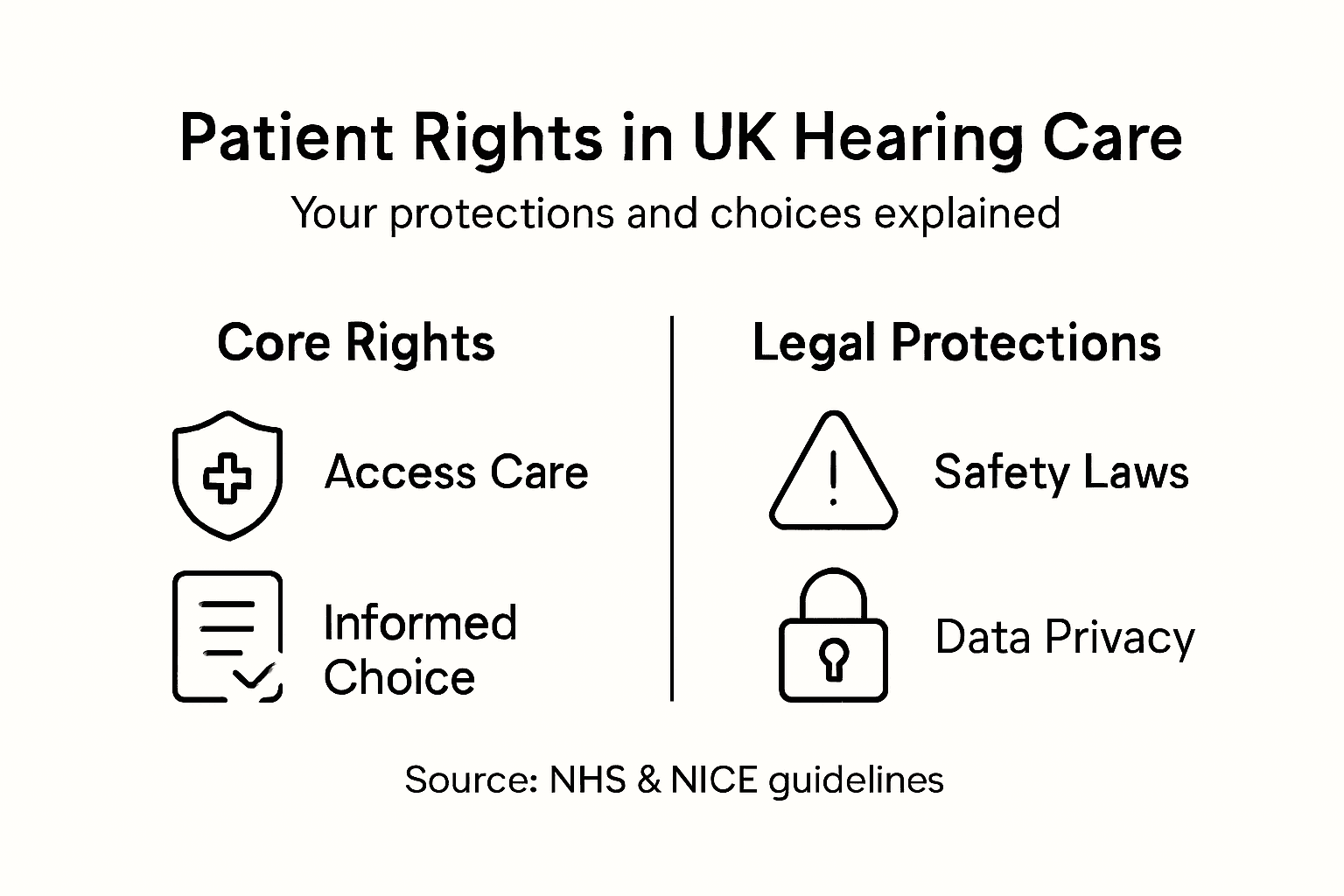
The real-world implications of these rights extend far beyond clinical interactions. NHS hearing loss support emphasises addressing broader social challenges such as communication barriers, potential isolation, and the psychological impact of hearing loss. Patients are entitled to transparent information about their condition, available treatments, potential outcomes, and support mechanisms that can help mitigate the broader life challenges associated with hearing impairment.
Legal and ethical standards mandate that healthcare providers adopt a holistic approach, considering not just medical treatment but also the patient’s overall quality of life. This includes providing communication support, ensuring equal access to services, protecting patient confidentiality, and offering mechanisms for feedback and complaint resolution. The framework aims to empower patients, reduce health inequalities, and create a supportive environment that recognises hearing health as a critical component of overall wellbeing.
Expert Tip: Always document your discussions with healthcare providers, request written explanations of your rights, and do not hesitate to seek a second opinion if you feel your concerns are not being adequately addressed.
Discover High-Quality Hearing Solutions That Follow UK Care Guidelines
Navigating the UK hearing care guidelines can be overwhelming with its focus on personalised assessments, device safety, and legal standards. If you are seeking discreet, effective hearing aids that meet these rigorous standards without the wait times and high prices of traditional services, Audora offers an innovative alternative. Our UKCA-certified digital hearing devices combine AI-powered technology with transparent pricing to deliver hearing enhancement tailored to your lifestyle.
Take control of your hearing health today with solutions designed to align with expert recommendations. Explore our premium selection of rechargeable, smartphone-compatible devices with invisible in-ear designs. Learn more about our complementary Accessories – Audora for a complete personalised experience and visit GetAudora.co.uk to experience affordable, modern hearing care on your terms. Don’t wait weeks or pay over the odds when advanced hearing technology is just a click away.
Frequently Asked Questions
What are the UK hearing care guidelines?
UK hearing care guidelines are a framework established to standardise and improve audiological services, ensuring high-quality patient care through comprehensive clinical recommendations from the National Institute for Health and Care Excellence (NICE).
What types of hearing devices are available?
There are various types of hearing devices available, including behind-the-ear (BTE), in-the-ear (ITE), in-the-canal (ITC) models, digital hearing aids, cochlear implants, and bone-anchored hearing aids, each designed for different levels of hearing loss.
How do NHS hearing services differ from private hearing services?
NHS hearing services are publicly funded and provide basic care at no cost, while private hearing services may offer a wider range of advanced devices and faster access, usually with associated costs for assessments and devices.
What should patients know about their rights in hearing healthcare?
Patients have the right to make informed choices about their treatment, receive personalised care, and access transparent information about their hearing condition and available support mechanisms.