

Waiting months for an NHS appointment or trudging to a high-street shop can leave many British adults feeling stuck when seeking help for mild hearing loss. Today, new UK Government guidance makes it easier than ever to access safe, affordable hearing aids without clinical barriers. You now have the freedom to try innovative devices at home with risk-free trials, letting you discover practical solutions tailored to your needs and lifestyle.
Table of Contents
- Step 1: Explore Available Risk-Free Hearing Aid Options
- Step 2: Select Your Ideal Device And Claim Trial Offer
- Step 3: Receive Your Hearing Aids And Set Them Up Correctly
- Step 4: Test Hearing Aids In Daily Situations At Home
- Step 5: Confirm Satisfaction Or Return Your Device Easily
Quick Summary
| Key Insight | Explanation |
|---|---|
| 1. Explore risk-free hearing aids | Look for providers offering no-obligation trials and money-back guarantees to test devices without financial risk. |
| 2. Schedule a hearing assessment | Consult an audiologist to identify personalized hearing aid options based on your specific lifestyle and preferences. |
| 3. Evaluate adjustments and support | Use manufacturer apps for device setup and adjustments; ensure professional support is available during the trial. |
| 4. Test in varying environments | Systematically assess hearing aids in different daily situations to determine sound quality and comfort. |
| 5. Understand return processes | Familiarise yourself with return conditions and documentation needed for a hassle-free return or exchange. |
Step 1: Explore available risk-free hearing aid options
Navigating hearing aid options in the United Kingdom has become simpler with recent government regulations. The UK now permits the sale of innovative over-the-counter hearing aids that allow individuals to test hearing technologies safely without traditional clinical barriers.
With these new guidelines, you can explore multiple risk-free hearing aid options directly from reputable providers. Most modern hearing aid services now offer comprehensive trial periods typically ranging from 30 to 45 days. These trials enable you to test devices in real-world environments and assess their performance without financial commitment. Look for providers offering complete money-back guarantees and free return policies to maximise your protection.
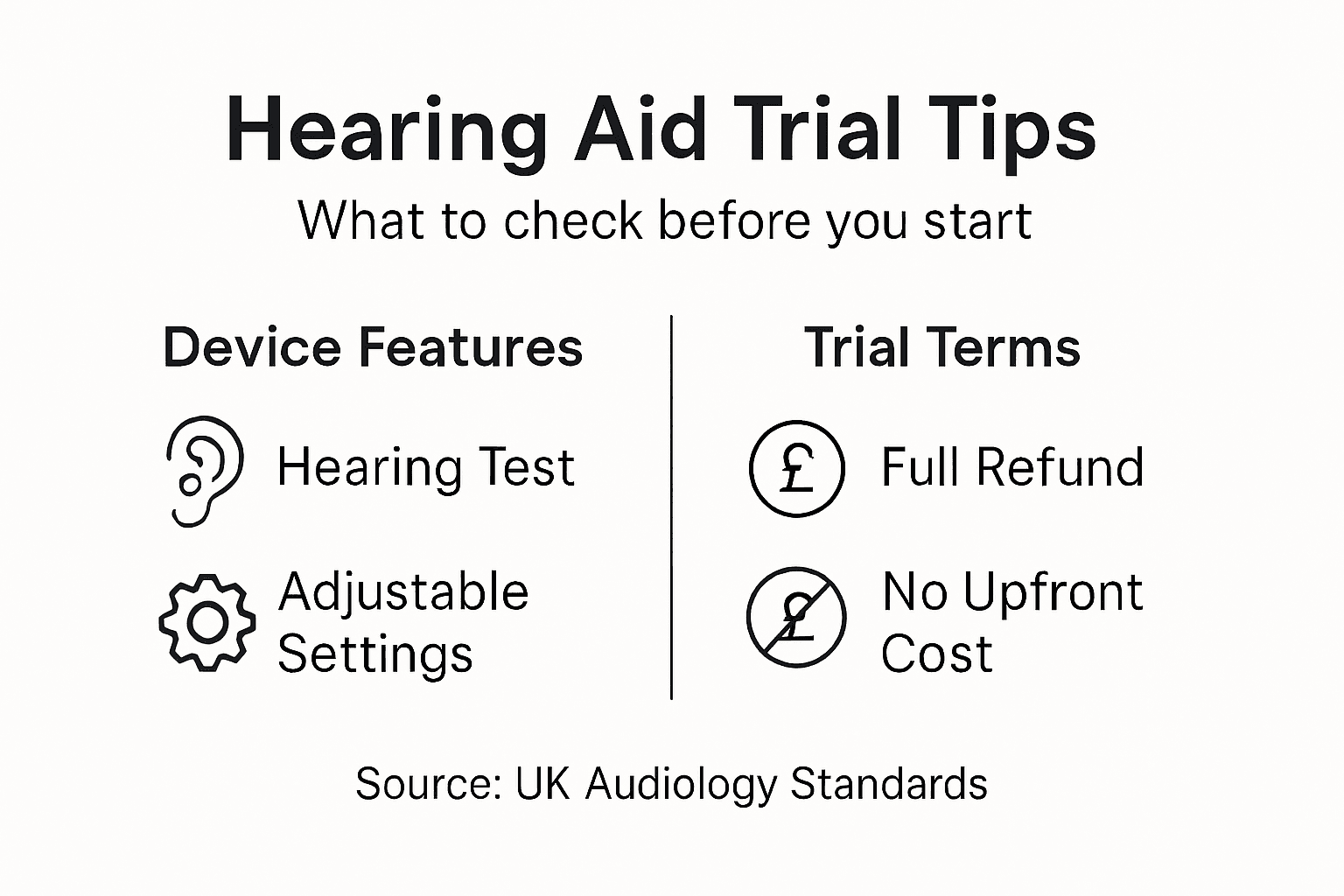
When selecting a risk-free hearing aid, prioritise devices with integrated hearing tests and adjustable settings. The UK government has specifically approved devices that allow users to manage hearing loss conveniently at home. Research potential providers carefully and review their specific trial conditions, ensuring transparent terms that protect your investment.
Insider Tip: Request comprehensive documentation about the hearing aid trial process and keep detailed records of your experience to facilitate potential returns or exchanges.
Step 2: Select your ideal device and claim trial offer
Choosing the right hearing aid involves understanding your specific hearing needs and finding a provider that offers comprehensive free hearing aid trials. Most modern providers now offer two-week trial periods that allow you to test devices in multiple environments before making a financial commitment.
Begin by scheduling a comprehensive hearing assessment with an audiologist who can recommend personalised device options. During this consultation, discuss your lifestyle requirements. Are you frequently in noisy environments like restaurants? Do you attend social gatherings or need hearing support for work? These details will help narrow down the most suitable hearing aid models. Ensure the provider offers multiple device styles such as behind-the-ear, in-the-ear, and completely-in-canal options to match your comfort and aesthetic preferences.

When reviewing trial offers, carefully examine the terms and conditions. Look for providers offering full refunds, no upfront costs, and professional support during the trial period. Some providers include additional services like device programming, follow up consultations, and technical support to ensure you have a seamless experience.
Below is a comparison of typical hearing aid styles found during trial periods:
| Style | Placement Location | Typical User Preference |
|---|---|---|
| Behind-the-ear (BTE) | Sits behind the ear | Maximum amplification, durable |
| In-the-ear (ITE) | Fits within ear shell | Discreet yet easy to handle |
| Completely-in-canal | Deep inside ear canal | Nearly invisible, minimalist |
Here is a summary of key considerations when reviewing hearing aid trial offers:
| Criteria | Why It Matters | What To Look For |
|---|---|---|
| Trial Period Length | Gives time to assess comfort | Minimum of 14 days recommended |
| Refund Policy | Protects your investment | Full refund with no restocking fees |
| Upfront Costs | Reduces financial pressure | No deposit or initial payment required |
| Professional Support Availability | Ensures a smooth experience | Access to audiologists during trial |
| Additional Services | Enhances user experience | Device programming and adjustments |
Top Tip: Request written documentation detailing the exact trial period terms and keep a record of all communications to protect your consumer rights during the hearing aid selection process.
Step 3: Receive your hearing aids and set them up correctly
Once your hearing aids arrive, carefully unpack them and review the hearing aid setup guide included with your devices. Modern hearing aids typically come with comprehensive instructions and user-friendly setup processes designed to make initial configuration straightforward for users with varying technical abilities.
Start by checking the battery or charging status of your devices. If they are rechargeable models, place them in the charging dock immediately to ensure full power. Most contemporary hearing aids feature intuitive smartphone apps that guide you through personalised fitting and initial calibration. Download the manufacturer’s companion app and follow the step-by-step instructions for connecting your devices. This digital support allows you to make initial volume adjustments and sound profile customisations from the comfort of your home.
During the first few days, wear your hearing aids in different environments to understand their performance. Pay attention to sound clarity, comfort, and how well they adapt to various background noise levels. If you experience any discomfort or notice unexpected sound quality, most providers offer complimentary professional support to help you fine tune your devices.
Expert Advice: Keep the original packaging and all documentation during your trial period, as these will be essential if you need to return or exchange your hearing aids.
Step 4: Test hearing aids in daily situations at home
Your two-week hearing aid trial provides an excellent opportunity to thoroughly evaluate device performance across various daily environments. Start by systematically testing your hearing aids in different household scenarios to understand their real-world functionality and adaptability.
Begin with quiet indoor settings like reading rooms or home offices, then progressively move to more challenging acoustic environments. Try conversations in the kitchen while background appliances are running, watch television with family members, or engage in phone conversations to assess sound clarity and device responsiveness. Pay special attention to how well the hearing aids reduce background noise and enhance speech intelligibility during different activities such as cooking, cleaning, or working from home.
Make detailed notes about your experience in different settings. Document aspects like comfort, battery life, sound quality, and any specific challenges you encounter. Most modern hearing aids feature smartphone app connectivity that allows you to make real-time adjustments, so experiment with these settings to find your optimal hearing configuration. If you notice consistent issues or unexpected performance, contact your provider for professional guidance during the trial period.
Expert Tip: Create a daily log documenting your hearing aid experiences, including specific environments, sound quality, and comfort levels to help you make an informed decision during your trial.
Step 5: Confirm satisfaction or return your device easily
As your trial period concludes, carefully evaluate your hearing aid performance against your initial expectations. Most hearing aid providers offer straightforward return processes designed to minimise customer stress and ensure complete satisfaction with your chosen device.
Begin by reviewing the specific return conditions outlined in your original purchase agreement. Check the exact timeframe for returns typically between 30 to 45 days from purchase date. Gather all original packaging, documentation, and accessories as these are often required for a successful return. Take detailed notes about your experience including specific challenges or benefits you encountered during the trial period. Many providers require a brief explanation or feedback form when processing returns, so preparing this information in advance streamlines the entire process.
To initiate a return, contact your provider directly through their preferred communication channel. Most modern hearing aid companies offer multiple return methods including online portals, email, telephone support, and postal returns. Be prepared to provide your order number, purchase date, and specific reasons for returning the device. Reputable providers will typically process refunds quickly and cover return shipping costs as part of their customer satisfaction guarantee.
Practical Advice: Photograph the hearing aids and packaging before shipping to create a personal record and protect yourself in case of any potential shipping disputes.
Experience Risk-Free Hearing Solutions with Audora Today
Struggling to find hearing aids that allow you to try before you buy can feel overwhelming. The article emphasises the importance of risk-free trials and transparent return policies to make confident choices about digital hearing technology. At GetAudora.co.uk, we understand your need for convenience, affordability and complete control over your hearing health. Our UKCA-certified hearing devices come with rechargeable batteries, smartphone app control and discreet designs that you can trial comfortably in your own home without lengthy clinic visits or NHS waiting lists.

Discover a simpler path to better hearing by exploring our wide range of premium hearing aids on our Home page – Audora. Enhance your trial experience with useful Accessories – Audora designed to optimise device usability and comfort. Don’t wait until hearing challenges interrupt your life. Act now to secure a high-quality, affordable solution that delivers peace of mind with full support and warranty. Visit https://getaudora.co.uk to start your risk-free hearing journey today.
Frequently Asked Questions
How can I explore risk-free hearing aid options?
You can explore risk-free hearing aid options by looking for providers that offer trial periods for their devices. Begin by researching reputable providers that allow you to test hearing aids for a minimum of 30 days, ensuring they have clear return policies in place.
What should I look for in a hearing aid trial?
In a hearing aid trial, prioritise offers that include a full refund option, no upfront costs, and professional support. Ensure that the trial period lasts at least two weeks to give yourself sufficient time to evaluate the device thoroughly.
How do I set up my hearing aids once I receive them?
To set up your hearing aids, follow the setup guide included with the devices, ensuring to check the battery or charging status first. Download your hearing aid’s companion app to adjust settings and calibrate the device for optimal performance.
What should I test during my hearing aid trial?
During your hearing aid trial, test the devices in various daily environments, such as quiet rooms, busy kitchens, and while watching television. Keep detailed notes about sound clarity, comfort, and how well the aids adapt to background noise.
How do I return my hearing aids if I’m not satisfied?
To return your hearing aids, review the return conditions in your purchase agreement and gather all original packaging and documentation. Contact your provider directly to initiate the return process, providing your order number and reasons for the return to facilitate a smooth transaction.
What documentation should I keep during the trial?
During your hearing aid trial, maintain all original packaging and documentation, as they will be needed for a return or exchange. Additionally, create a daily log of your experiences with the devices to help you make a well-informed decision.