

Modern hearing aids are changing lives, with over 80 percent of users now choosing styles that are barely visible. Gone are the days when clunky devices drew unwanted attention. Today, advanced digital technology allows people to enjoy natural sound while keeping their hearing support private. This article explores the blend of cutting-edge engineering and thoughtful design that makes contemporary hearing aids truly discreet.
Table of Contents
- What Makes Hearing Aids Discreet Today
- Evolution of Hearing Aid Design and Size
- Invisible and In-Ear Devices: Key Innovations
- How Digital Technology Enables True Discreteness
- Comparing Discreet Models to Older Alternatives
- Benefits of Modern Discreet Hearing Aids
Key Takeaways
| Point | Details |
|---|---|
| Discreet Design Innovations | Modern hearing aids feature miniaturised components and in-ear designs that allow for nearly invisible wear, enhancing user confidence. |
| Digital Advancement | The integration of sophisticated digital processing capabilities ensures superior sound quality and personalized experiences tailored to individual needs. |
| Psychological Impact | Contemporary hearing aids eliminate the social stigma associated with earlier devices, empowering users to engage positively in social interactions. |
| Seamless Integration | Modern models offer wireless connectivity, allowing users to connect effortlessly with digital devices for enhanced functionality and ease of use. |
What Makes Hearing Aids Discreet Today
Today’s hearing aids have transformed dramatically from the bulky, conspicuous devices of decades past. Modern digital hearing technology now prioritizes miniaturisation and aesthetic design, allowing individuals experiencing hearing loss to access sophisticated sound enhancement without drawing unnecessary attention.
The key factors contributing to modern hearing aids’ discretion include:
- Miniaturised Components: Advanced microelectronics enable hearing devices smaller than a fingernail
- In-Ear Designs: Completely invisible or nearly undetectable models that sit deep within the ear canal
- Skin-Tone Colour Matching: Devices designed to blend seamlessly with natural skin tones
- Sophisticated Digital Processing: Compact chips delivering superior sound quality in tiny packages
Specifically, manufacturers have focused on developing micro-digital hearing aids that are substantially smaller than traditional models. These contemporary devices leverage cutting-edge semiconductor technology to compress sophisticated audio processing capabilities into remarkably compact form factors. Some modern hearing aids are so small they can be entirely concealed within the ear canal, rendering them virtually invisible to observers.

The technological evolution has been driven by consumer demand for discreet solutions that do not compromise on performance. Individuals now expect hearing enhancement technologies that integrate seamlessly into their lifestyle, providing natural sound reproduction without social stigma. Audora™ Hearing Aids represent this modern approach - delivering high-quality sound enhancement in designs that prioritise both technological capability and personal dignity.
Evolution of Hearing Aid Design and Size
The journey of hearing assistance technology is a fascinating narrative of human innovation, stretching back centuries. Wikipedia notes that ear trumpets for the partially deaf date back to the 17th century, with the earliest description documented in 1634 by Jean Leurechon. These early acoustic devices were bulky, conspicuous contraptions made from materials like brass, copper, and even animal horns, designed to funnel sound into the ear.
The progression of hearing aid technology can be mapped through several critical phases:
- Acoustic Era (17th-19th Centuries): Large, non-electronic ear trumpets and speaking tubes
- Electronic Transition (Early 20th Century): First carbon and vacuum tube hearing aids
- Transistor Revolution (1950s): Significantly smaller, more portable devices
- Digital Transformation (1990s-Present): Miniature, sophisticated sound processing technologies
Modern hearing aids represent a quantum leap from their historical predecessors. Where early devices were massive, uncomfortable, and socially stigmatizing, contemporary technologies are compact, nearly invisible, and packed with advanced digital signal processing capabilities. Hearing Aids Comparison Review demonstrates how manufacturers have dramatically reduced device size while exponentially increasing performance, creating solutions that seamlessly integrate into users’ lives.
The most remarkable aspect of this evolution is not just size reduction, but the profound improvement in sound quality, battery efficiency, and user experience.
Today’s hearing aids are sophisticated minicomputers that can adapt to different acoustic environments, connect wirelessly to smartphones, and provide crystal-clear sound reproduction - a far cry from the rudimentary acoustic amplification devices of previous centuries.
Invisible and In-Ear Devices: Key Innovations
The quest for truly invisible hearing aids has been a game-changing journey in auditory technology. Modern in-ear hearing devices represent the pinnacle of discretion, engineering miniature sound enhancement technologies that can be completely concealed within the ear canal, transforming how individuals experience hearing assistance.
Key innovations driving invisible hearing aid development include:
- Micro-Acoustic Engineering: Developing incredibly small components without compromising sound quality
- Custom Ear Canal Molding: Precise digital scanning to create perfectly fitted devices
- Advanced Sound Processing Chips: Powerful microprocessors smaller than fingernails
- Adaptive Noise Reduction: Intelligent algorithms that filter background sounds in real-time
These technological breakthroughs enable two primary invisible hearing aid designs. The first is the completely-in-canal (CIC) model, which sits deep inside the ear canal, rendering it virtually undetectable from the outside. The second is the invisible-in-canal (IIC) design, which sits even deeper, providing maximum discretion and a natural listening experience. Audora™ Comfort Hearing Aids exemplify this cutting-edge approach, offering solutions that prioritize both aesthetic subtlety and superior sound reproduction.
The psychological impact of these innovations cannot be overstated. By eliminating the social stigma traditionally associated with hearing devices, invisible hearing aids empower users to engage confidently in social interactions, professional environments, and personal relationships without feeling self-conscious about their hearing assistance technology.
How Digital Technology Enables True Discreteness
Digital technology has revolutionized hearing aid design, transforming these devices from simple acoustic amplifiers into sophisticated, intelligent sound processing systems. arXiv research highlights how advanced deep learning frameworks like CLCNet are now enabling unprecedented noise reduction and speech enhancement capabilities, directly contributing to the discreteness and effectiveness of modern hearing aids.
The core digital innovations enabling true discreteness include:
- Miniature Signal Processors: Powerful microchips that can analyse and modify sound in milliseconds
- Adaptive Noise Cancellation: Intelligent algorithms that distinguish between speech and background noise
- Machine Learning Sound Optimization: Continuous real-time audio environment adaptation
- Wireless Connectivity: Seamless integration with smartphones and other digital devices
These digital technologies work in concert to create hearing aids that are not just smaller, but fundamentally smarter. Advanced neural network algorithms can now distinguish human speech from environmental noise with remarkable precision, allowing users to focus on conversations while automatically suppressing irrelevant background sounds. This means wearers can engage in complex acoustic environments like busy restaurants or crowded meetings without struggling to hear or drawing attention to their hearing device.
The most remarkable aspect of digital technology in hearing aids is its ability to personalize sound experiences. Modern devices can learn a user’s hearing preferences, automatically adjusting equalization, volume, and noise reduction in real-time. This intelligent adaptation means hearing aids now function more like personal sound assistants than mere amplification devices, providing a natural, almost invisible hearing enhancement experience.
Comparing Discreet Models to Older Alternatives
The evolution of hearing assistance technology represents a dramatic transformation from conspicuous, bulky devices to nearly invisible solutions. Wikipedia documents that ear trumpets, used since the 17th century, were large and embarrassingly obvious acoustic devices that drew significant social attention, dramatically different from today’s discreet hearing technologies.
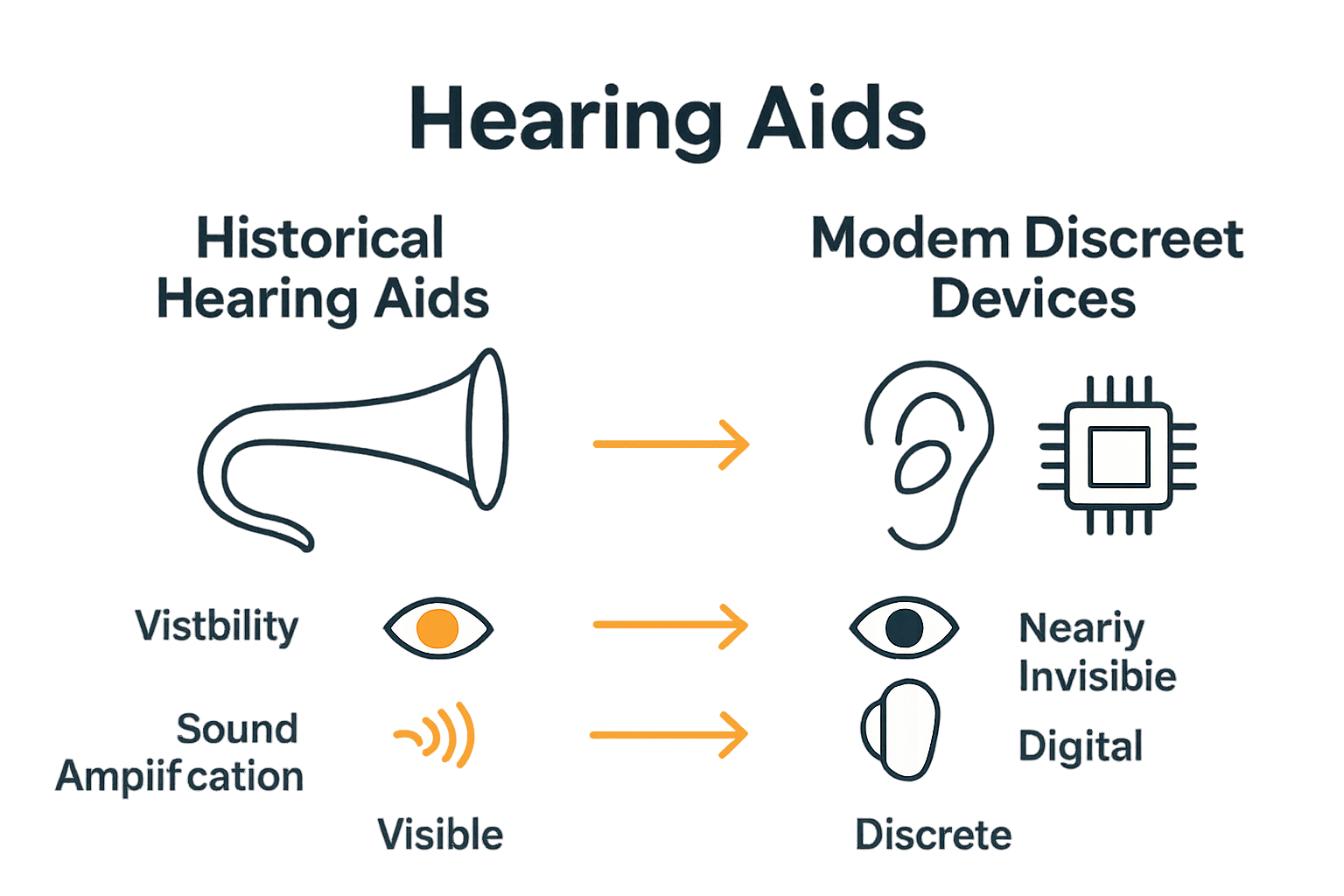
A stark comparison between historical and modern hearing aids reveals remarkable differences:
- Size: Ear trumpets measured 30-40 cm, modern devices are smaller than a fingernail
- Visibility: Historical devices were impossible to conceal, current models are virtually undetectable
- Sound Quality: Acoustic trumpets offered minimal amplification, digital devices provide nuanced sound reproduction
- Social Perception: Previous technologies signaled disability, modern designs integrate seamlessly
Wikipedia highlights how the Sonotone 1010, introduced in 1952, marked a significant milestone as the first commercial transistor-based hearing aid. This breakthrough began the miniaturization process, transitioning from massive vacuum tube designs to more compact electronic systems. Modern hearing aids have since advanced exponentially, becoming sophisticated digital devices that can adapt to complex acoustic environments with unprecedented precision.
The psychological impact of this technological evolution cannot be understated. Where older hearing assistance technologies created social barriers and potential embarrassment, contemporary devices empower users to engage confidently in conversations, professional settings, and personal interactions without feeling self-conscious about their hearing enhancement technology. The transformation represents not just a technological upgrade, but a profound shift in how society perceives hearing assistance.
Benefits of Modern Discreet Hearing Aids
Modern discreet hearing aids represent a transformative leap in hearing assistance technology, offering unprecedented advantages that extend far beyond simple sound amplification. Manchester Professionals highlights that these devices are custom-molded for each wearer, ensuring a comfortable and secure fit that dramatically improves sound transmission and minimizes the risk of device displacement.
The key benefits of contemporary discreet hearing aids include:
- Psychological Confidence: Eliminating social stigma associated with traditional hearing devices
- Superior Sound Quality: Advanced digital processing that adapts to complex acoustic environments
- Personalized Fitting: Precisely molded to individual ear canal specifications
- Wireless Connectivity: Seamless integration with smartphones and digital devices
These advanced hearing solutions go beyond mere technological innovation. They represent a profound shift in how individuals experiencing hearing loss can interact with the world. Modern devices are so sophisticated that they function more like intelligent personal sound assistants, capable of learning and adapting to individual hearing preferences in real-time. Audora™ Comfort 2.0 exemplifies this approach, offering users a hearing experience that is both technologically advanced and remarkably natural.
Perhaps the most significant benefit is the restoration of personal agency. Where older hearing devices made users feel conspicuous and different, modern discreet hearing aids empower individuals to engage confidently in social, professional, and personal interactions. They transform hearing assistance from a medical necessity into a seamless, almost invisible enhancement of one’s natural sensory experience.
Discover the Power of Truly Discreet Hearing Aids Today
Living with hearing loss does not have to mean compromising your confidence or daily comfort. This guide highlights how modern hearing aids use advanced digital technology and invisibly small designs to bring natural sound back into your life without drawing attention. If you want to enjoy superior sound quality in nearly invisible devices that fit perfectly and adapt intelligently to your environment, we have the solution.

Explore our carefully curated collection at Home page – Audora to find UKCA-certified, AI-powered hearing aids designed with your discreetness and convenience in mind. At https://getaudora.co.uk, you can purchase innovative hearing enhancements at a fraction of traditional prices, backed by full support and warranty. Take control now and enjoy the confidence that comes with discreet, cutting-edge hearing technology without the wait or endless appointments.
Frequently Asked Questions
What are the main reasons hearing aids are now more discreet?
Modern hearing aids are more discreet due to miniaturised components, in-ear designs, skin-tone colour matching, and sophisticated digital processing that allows for smaller devices without compromising sound quality.
How do invisible hearing aids work?
Invisible hearing aids, such as completely-in-canal (CIC) and invisible-in-canal (IIC) models, use advanced micro-acoustic engineering and custom ear canal molding to create devices that fit deeply within the ear, making them nearly undetectable while providing powerful sound enhancement.
What are the benefits of using modern discreet hearing aids compared to older models?
Modern discreet hearing aids offer superior sound quality, personalized fitting, improved psychological confidence, and wireless connectivity, transforming the user experience from simple amplification to intelligent sound assistance, reducing the social stigma associated with hearing devices.
How has digital technology improved hearing aids’ discreteness?
Digital technology has improved hearing aids by incorporating miniature signal processors for real-time sound analysis, adaptive noise cancellation, machine learning for personalization, and wireless connectivity, enabling discreet designs that deliver enhanced performance and user comfort.